Friday, March 25, 2011

Regarding these Arab uprisings: Don't get your hopes up

The unrest in the Arab Middle East underscores the superiority of Israel and why that small nation deserves the full support of the United States.
While angry citizens in Tunisia, Egypt, Libya, Syria, Saudi Arabia, Yemen, Iran, Jordan and Morocco rise up against a panoply or dictators and “kings,” Israel has been peacefully changing governments through the democratic process for some six decades.
Israel is an island of civilized modernity surrounded by a sea of stone age tribal territories.
Certainly there are a lot of hard working Arabs who live in these unstable countries who want better lives for themselves and greater freedoms. Many have immigrated to the United States and have become valued and productive members of our society. However, as we saw in Iran, hardline Islamists rush in to fill the power vacuum when the local Arab strongman gets pushed aside, and they play the game for keeps.
Through many Democratic and Republican administrations the United States has pledged to stand on the side of democracy. Our loyalty to Israel will test this commitment.
Today there is no reason to suspect that a so-called Palestinian state will be anything other than a repressive regime controlled by Islamists. When the United States pushes Israel to make concessions to the Palestinians we weaken the only true democracy in the area and pave the way for the establishment of another Iran or Syria. Such a state will do everything it can to destroy Israel and repress its own people if they dare to question the ruling class.
By fomenting hatred toward Jews and Israel, these repressive regimes remove the focus from themselves. Blaming all the ills of the world on the “Jews” takes the pressure off their backward and corrupt political and economic systems. It’s an ancient tactic.
Further, I believe any hope we might allow ourselves that today’s “revolutions” in these countries will result in less repressive and more democratic counties is just a pipe dream. As Westerners we have an almost built in notion that a popular uprising will lead to progressive changes. We need to set that aside when we look at what is happening in the Arab Middle East.
In many ways Arabic nations were more progressive and ready to engage the world in a positive way a thousand years ago than they are today. Earlier this year Jack Donaghy on “30 Rock” quipped that since the invention of democracy, Greece has been “coasting.”
Since they exported Hindu-Arabic numerals to Europe in the 10th century, you could say the same thing for the Arab world.

Monday, March 14, 2011

Huge corporations: My best friends

It seems to me that people who are critical of our economic system believe to a large extent that producers have an unfair advantage over consumers. They think that corporations—a word that critics of free enterprise do everything they can to sully—essentially hold all the cards.
Sometimes it might appear that way, but when you start to assemble a list of large companies that have gone out of business you realize that consumers do, ultimately, wield sufficient power to balance the equation.
Consider Blockbuster. Okay, technically it’s not out of business yet, but when you roam the corridors of corporate America shouting, “Bring out your dead,” Blockbuster is definitely going to get tossed into your cart.
At one time Blockbuster seemed to dictate what we would pay for video rentals. Remember all the late fees? Eventually consumers moved on to more appealing video delivery companies.
There is a natural ebb and flow in the economic contracts between consumers and suppliers. There are times when producers seem to have the upper hand. Corporations can charge a hefty price for their products when they make an innovation that gives them clear superiority over their competitors. We see this especially in technology and pharmaceuticals.
However, the competition soon catches up and then more power goes to consumers who can be picky about price points and various competitive features between products.
My first computer was a Commodore VIC-20. This little machine was the world’s first computer to sell over one million units. Despite this, the company is defunct today. Consumers walked away from it.
That little computer by the way, cost $300 when it was introduced in 1980. That would be about $850 today. This was a computer that had less than 20 kilobytes of memory. Yes, 20K. Consider the computer that $850 would buy today.
A critic might say that computers are more powerful and relatively less expensive today because of technological innovations. This is, of course, true. But, run the entire scenario through your mind. How long could producers get away with making and selling a computer with 20K memory for $300. Not very long. (The Soviets tried producing consumer goods using that tactic and you can see where it got them.)
In other words, consumer demand for those low power computers dried up. Consumers wanted more for their money. This is what drives innovation.
I’m old enough to remember when Pan Am was “the” international airline to fly. I suppose that most people today only know the corporation for the small appearance it makes in the Leonardo DiCaprio movie, “Catch Me If You Can.” It seemingly controlled international air travel.
Today, it’s a very interesting chapter in commercial airline history.
Maybe the best example of consumer power involves the Coca-Cola company. Can you imagine a more powerful global corporation than Coca-Cola? I don’t think so, yet all its corporate muscle couldn’t sell consumers on “New Coke.” The company took a major bath on that product.
If you still think that corporations are all powerful, I suggest you go start your own corporation and see how far you get trying to manipulate consumers. Oh, but you say that you’re talking about big corporations, not little startups.
Okay fine, but try to get big by ignoring consumer demand. Then, once you are big, try to stay that way by ignoring consumer demand.
So far that strategy hasn’t worked so well for AOL, Newsweek, Hummer or Woolworth’s.

Saturday, February 26, 2011

'Anchor baby' problem solved

The immigration problem caused by “anchor babies” has created a great deal of controversy lately. I believe I have a solution to this thorny issue that should please both sides of the debate and help alleviate other social problems as well.
When an illegal immigrant, or “undocumented” immigrant if you prefer, comes to this country and gives birth to an “anchor baby”—a term, by the way which has nothing to do with the baby’s physical appearance, but is used to communicate the fact that the family’s residence becomes more “anchored” in the United States by virtue of the child—we should allow that child, when he or she becomes a teenager, to decide whether or not to deport his or her parents.
In my experience, the vast major of teenagers would kick their parents out of the country if given the chance. With my approach to this problem, federal immigration authorities are no longer the “bad guy” so I don’t think there’s much room for anyone to complain.
Yes, you say, but what about those families where the relations between their teenage sons and daughters are sufficiently amicable that the teenagers would not deport their parents? In those cases, and I anticipate this to occur only very infrequently, the parents must have some secret piece of child rearing knowledge that could benefit us all.
These people should be given jobs where they more or less raise our children for us. They can work as nannies and maids, for example. And fortunately, we already have this part of my system largely in place.
Problem solved.

Thursday, February 24, 2011

Why not make OJ and Lindsay Lohan cellmates?

Lindsay Lohan is just crying out for help.
Lindsay Lohan is just crying out for jail time.

Wednesday, February 23, 2011

Wherein I turn a 53-word Facebook status update into a fully realized 524-word essay full of important insights.

As I searched for good and important subjects for this blog, I discovered a fertile source of material that has, to date, been mostly unexplored by serious writers: my recent Facebook status updates.
For example, yesterday I posted the following:
I got really upset today when I heard that Americans drink so many bottled waters every year that the bottles, when laid end to end, would stretch around the world 100 times. It mostly bothered me that we don’t live on a bigger planet so people couldn’t make this kind of stupid comparison.
After I deftly crafted those two sentences, I copied and pasted them into that long and thin “What’s on your mind” rectangle and pressed “share.” I then sat back and waited for the “LOLs” and smiley face icons to appear.
I was quite disappointed.
Only one person responded, my BcFF (best childhood friend forever) and she said this:
Check out the artist Chris Jordan...similar topics and some really interesting work.
I did check out the artist Chris Jordan. His work is critical of American consumerism. I now think that my BcFF didn’t read the second sentence of my post. That suspicion and the fact that—aside from the aforementioned single ill-conceived response—my post so far remains bereft of responses, I feel I need to develop this theme somewhat further and, as I sit here thinking about it, this will naturally lead to a whole series of blogs based on my misunderstood, or overlooked, cleverly worded Facebook status updates.
However, let me set my introductory comments aside for a moment and explain this specific, hilarious status update.
You see, the circumference of the earth is almost 24,902 miles. The water bottle statement implies that a train made from our plastic bottles would stretch for 2,490,200 miles. As a side note, I might mention that I think the original statement would have been even better had they used the other old standby impressive distance comparison: “to the moon and back.”
The one-way distance to the moon is 238,857 miles, so they could have said that if laid end-to-end, we use enough plastic water bottles in a year to stretch from the moon and back more than five times. Personally I prefer the “moon and back” comparison because it always reminds me of Tom Hanks’ heroics in, “Apollo 13.”
Even more than that however, I am generally tired of these types of comparisons and truly wished we lived on a planet such as Jupiter. The circumference of Jupiter at 279,118 miles is, interestingly enough, even further than the distance between the earth and the moon. So, if we lived on Jupiter I could actually turn this statement against the environmentalists and say something like, “You know, if stretched end to end, all the plastic water bottles we use in a year wouldn’t even stretch around Jupiter 10 times!”
That would be telling them!
However, if you paid any attention at all in your high school science classes, you’ve probably already picked up on an even more salient fact: there is virtually no water on Jupiter, therefore no water bottles.
I rest my case.

Monday, February 21, 2011

Damn You Ken Jennings

Only humans use tools.
Only humans mourn their dead.
Only humans can play Jeopardy.
Only humans bother listing things they mistakenly believe only they can do.

Thursday, February 17, 2011

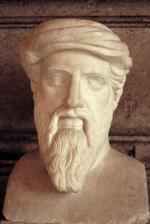
Need a (cheap) life coach? Try Pythagoras

The self-help shelves at the book store are overflowing. Demand for "life coaches" is at record levels.
Save your money. Take some free advice from a guy who was in his prime about 2500 years ago, Pythagoras.
We all know the name. And depending on your attitude toward math you probably either love him or hate him. No one can avoid A2 + B2 = C2 . That fact alone should tell us that Pythagoras was a man we should listen to. The Greek philosopher and mathematician came up with this truth almost three millennia ago and we're still teaching it in school.

I don't think that will be true for any of the self-help authors who are pumping out today's bestsellers.
Last night I was reading a general interest book on math and the author spent a few pages outlining some biographical information on Pythagoras. Pythagoras took on students. He impressed upon them a few simple disciplines. You can fire your life coach if you adopt these for yourself.
First he made them establish a strict routine for going to bed at night and getting up in the morning. That's simple enough, although it's often hard to do.
But, when you combine this with two little rhymes Pythagoras had his students memorize and obey, it can be life changing.
Commit this to memory:
As soon as you awake, in order lay
the actions to be done in the coming day.
Don't hit the snooze button. Don't lie in bed day dreaming. Lay out what you need to accomplish. If you're an iPhone person, get yourself an app and enter all "the actions to be done in the coming day."
Pythagoras then had his students "close the loop"—if I can borrow a phrase from the days when I worked as a quality control engineer in the electronics industry—with another short rhyme they were required to memorize and recite at the end of the day:
Allow not sleep to close your eyes
Before three times reflecting on
Your actions of the day. What deeds
Done well, what not, what left undone?
Before you nod off at night, make an honest evaluation of what you were able to accomplish from the list of actions you laid out for yourself in the morning. Note the qualitative aspect of this evaluation. What did you do well? What did you do, but perhaps poorly? Then, of course, what did you fail to do?
For many of us, our days look more like this flow chart than the disciplined approach to life that Pythagoras instilled in his students.
I don't expect my legacy to last nearly as long, or have any impact like A2 + B2 = C2 , but maybe if I start my days with a clear understanding of the actions I need to take, and spend a few moments at night to honestly reflect on my day, I will be a better person and have more to offer my family and friends.
I don't suppose they had business cards back in the days of Pythagoras. But if they did, he could have listed "life coach" along with mathematician and philosopher. And, I think his rules to guide our relationship to the tasks of our daily life are just as enduring as his formula that defines the relationship of the sides of a right triangle.